
How CAN-Bus Mileage Blockers Work: Updated Technical Guide
Understand how does a mileage blocker work in practice. Explore CAN-bus communication, odometer filter modules, technical limits, and vehicle architecture.
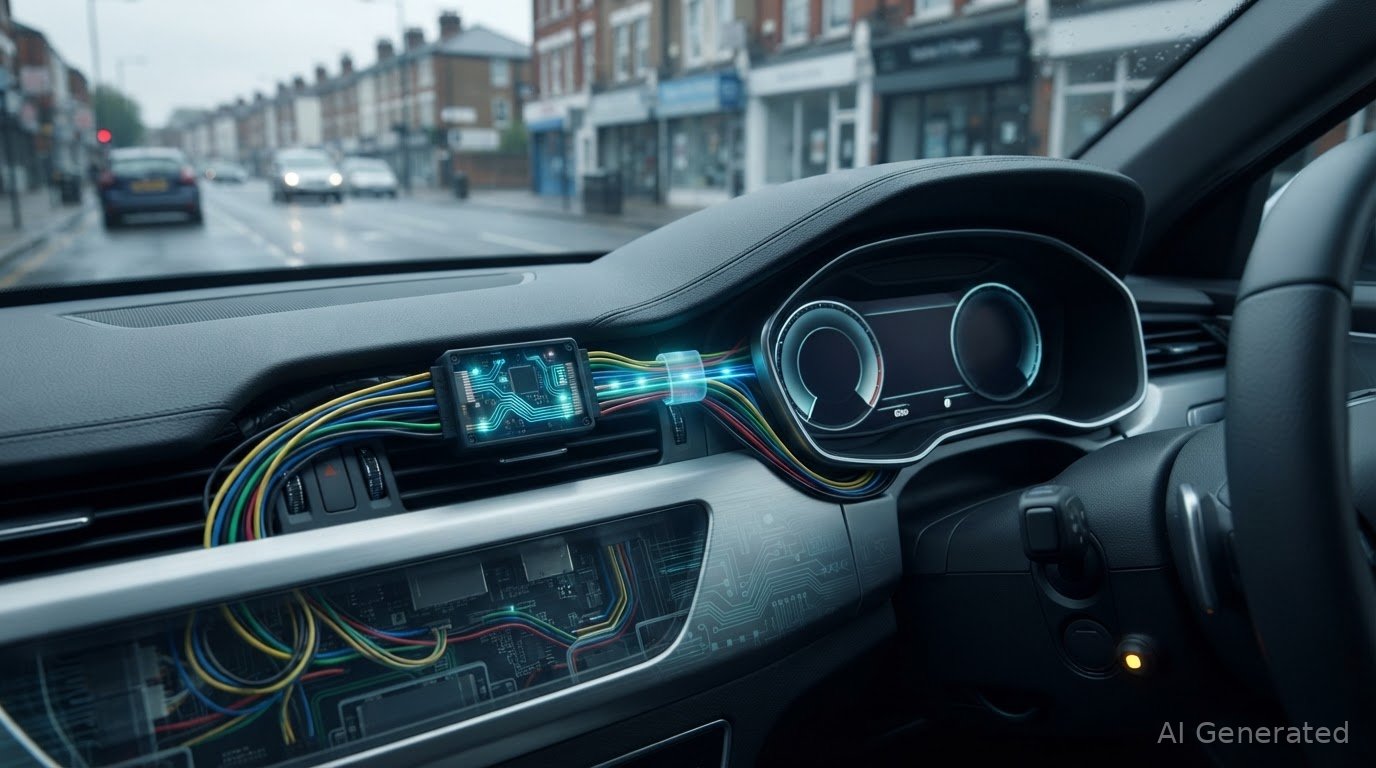
Technical descriptions of mileage blocker systems can be difficult to interpret, especially when they mix broad explanations with details that apply only to particular applications. If you’re asking how does a mileage blocker work, a useful starting point is to separate what a general guide can explain from what depends on the vehicle and product in question.
This guide takes that measured approach. It offers a framework for reading technical descriptions, understanding where general explanations have limits, and identifying the details that matter when assessing a specific application. The aim is clarity, not a substitute for vehicle-specific product information. Use the sections that follow to build a sound understanding of the subject before considering any product or its intended use.
Key Takeaways
- Understand how does a mileage blocker work at a basic level: it is a vehicle-specific CAN-bus module designed to pause odometer recording during testing.
- Use the vehicle’s make, model, year and cluster type to identify the relevant product information.
- Distinguish pausing mileage recording from correcting mileage already recorded or making claims about other stored vehicle data.
- Keep the stated limits in mind: mileage blockers are intended for controlled testing, tuning and R&D, not to misrepresent a vehicle’s mileage.
How does a mileage blocker work at a basic level?
At a basic level, a mileage blocker is an electronic module designed to pause odometer recording during testing. It interacts with a vehicle’s electronic communication environment, rather than acting as a tool for editing the mileage figure already shown. For an accessible introduction to the product category, the plain-English mileage blocker guide explains the basic terminology.
What does ‘pausing odometer recording’ mean?
Pausing odometer recording means the odometer does not record distance in the intended way while the blocker is active. It describes a temporary recording function, not mileage correction. A pause should not be confused with rewriting a figure that has already been recorded. This definition also makes no claim about how other vehicle data behaves, which can only be established through information specific to the vehicle and product.
What does CAN bus mean in this context?
CAN bus, short for Controller Area Network, is an electronic communication network used by vehicle systems to exchange information. The term gives useful context for understanding the device, but it does not identify a universal message route or explain every product’s implementation. The CAN bus Wikipedia article provides a general introduction to the network and its role in vehicles.
In practice, the electronic arrangement differs between vehicles. The CAN-bus label alone cannot tell you which hardware, firmware or operating details apply to a particular car. Those specifics belong to the relevant product information, not to a category-wide definition. This distinction keeps a simple explanation useful without treating it as a technical specification for every vehicle.
How does a CAN-bus mileage blocker interact with vehicle electronics?
Vehicle systems exchange information through electronic networks, and odometer recording forms part of that wider electronic environment. A CAN-bus mileage blocker is designed to interact with the vehicle’s electronics for its stated recording-pause function. A general description cannot, however, establish a particular data route or explain exactly how a specific vehicle handles the interaction. The broader context of mileage across vehicle systems is covered in this guide to mileage across multiple ECUs, but it should not be treated as evidence of blocker behaviour.
Why is there no single operating method for every car?
Vehicle electronic systems and their configurations vary. As a result, a general explanation of CAN-bus interaction cannot be applied as a universal operating description. A product’s own information is the relevant reference for its intended application. Details from one car should not be carried across to another, even if the models appear similar. This is a practical distinction: the shared technology term does not mean every vehicle uses the same implementation.
What can a general explanation not establish?
A high-level account cannot confirm what a particular vehicle’s dashboard will display, whether warning lights may appear, or what diagnostic effects may occur. These points must not be inferred from a category-wide description. They require information specific to the product and vehicle in question. The linked ECU guide provides wider context about vehicle mileage records, not a guarantee about how a blocker interacts with any particular system.
For general product and usage information, consult the MileageBlocker FAQ.
What does a mileage blocker do, and what are its limits?
A mileage blocker’s stated function is to pause odometer recording for an intended technical test. That is distinct from correcting mileage already recorded. The function alone does not establish how other vehicle data behaves, so it should not be presented as proof that stored information elsewhere has been changed, removed or left unaffected. Understanding how does a mileage blocker work therefore also means understanding what the device is not intended to do.
Which uses are within the stated purpose?
Designed for off-road, testing, tuning and R&D use. Carcode mileage blockers are sold strictly for legitimate automotive testing, tuning and diagnostic purposes. They are intended for use on private property, rolling roads and controlled test environments only. These limits define the stated use; they do not suggest suitability for public-road use. For broader context, read this guide to legitimate mileage-blocker uses.
Why must the vehicle’s recorded mileage not be misrepresented?
A pause in recording must not be used to present a vehicle’s mileage inaccurately when it is advertised or sold. It is illegal to use a mileage blocker to misrepresent a vehicle’s true mileage when selling or advertising it. It should not be used to alter the recorded mileage of any vehicle being offered for sale. This is a firm boundary, separate from the device’s stated role in controlled technical testing.
Carcode Ltd accepts no liability for misuse. By purchasing, customers confirm they will use the product lawfully and responsibly. These statements set out the conditions of responsible use without making claims about how a specific vehicle stores or reports mileage.
For more information about the stated use and limitations, review the MileageBlocker FAQ.
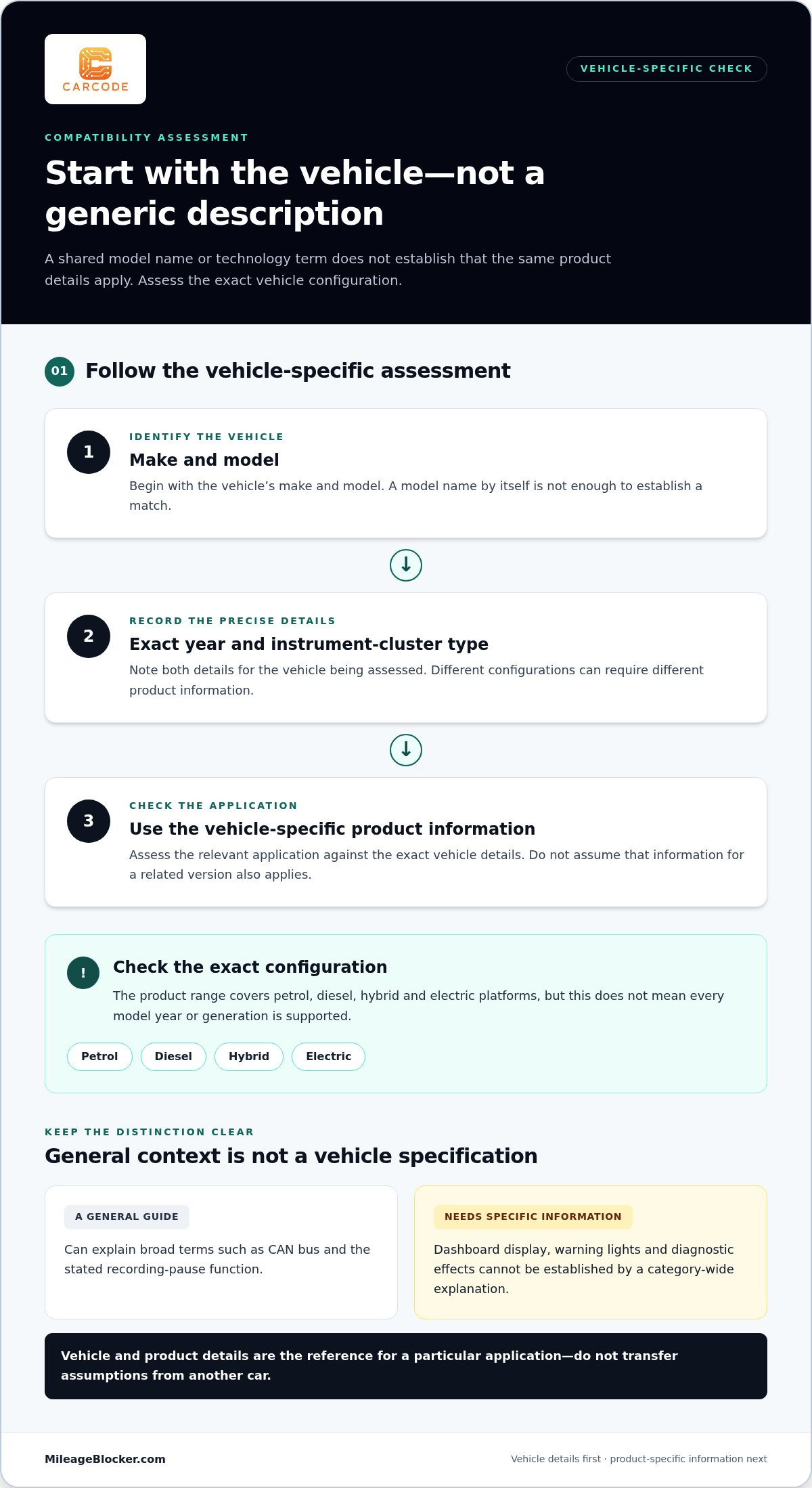
How should you assess a mileage blocker for a specific vehicle?
Start with the vehicle, not a generic description of how a mileage blocker works. Compatibility depends on the exact application, so a shared model name alone is not enough to establish a match. Use this sequence:
- Identify the vehicle’s make and model.
- Record its exact year and instrument-cluster type.
- Use the vehicle-specific product information to assess the relevant application.
Petrol, diesel, hybrid and electric platforms are covered across the product range, but that does not mean every model year or generation is supported. Check the information for the precise vehicle configuration rather than assuming that a listing for a related version also applies.
What vehicle details help establish compatibility?
The exact year and cluster type are key matching details. Generations and configurations can differ, even within the same model range, so a product intended for one version should not be assumed to suit another. Use the vehicle-specific information to assess the application; general descriptions cannot establish an installation location, connector type or operating procedure.
What should readers expect from the manufacturer?
MileageBlocker.com units are hand-built and bench-tested in the UK. This describes how they are prepared, not a promise of a particular test result for every vehicle. The manufacturer wording is direct: designed, manufactured and supported by Carcode Ltd - no middlemen, no white-labelling, no compromises. Product installation is described as approximately 15-30 minutes, a general stated estimate rather than a universal guarantee. Installation details can vary by product application.
For practical guidance on product information and use, view the MileageBlocker.com FAQ.
Choose the right vehicle-specific information
The practical next step is to assess the exact vehicle application before drawing conclusions from a general explanation. Make, model, year and cluster configuration help distinguish one product application from another, even where vehicles share a model name. This is the difference between understanding the principle and selecting information relevant to a particular vehicle.
So, how does a mileage blocker work in the context of your vehicle? The answer depends on its specific electronic configuration and the product matched to it. MileageBlocker.com’s range supports 45+ car makes, with vehicle-specific information guiding selection. Keep any use within the stated controlled testing purpose, and don’t treat a recording pause as a change to previously recorded mileage.
Before taking the next step, review the product and usage information for the application you’re considering. Review the MileageBlocker.com FAQ for product and usage information, then proceed with a clear understanding of the vehicle-specific details and responsible-use limits.
Frequently Asked Questions
Can every mileage blocker work the same way across different vehicles?
No. Product information applies to a specific vehicle application, and the exact year and cluster type matter. Two vehicles with the same model name can have different generations or configurations, so don’t use one vehicle’s mode, fitting details or dashboard behaviour as a guide to another. Match the product information to the vehicle in question before relying on any specification.
Does a mileage blocker change mileage that has already been recorded?
No. The stated function is to pause odometer recording during testing, diagnostics, tuning and dyno runs. That description does not establish what happens to previously recorded mileage or data in other vehicle modules. In practical terms, a paused odometer should not be taken as evidence that an existing mileage figure has been corrected. The phrase “how does a mileage blocker work” describes its stated function, not a mileage-history check.
Can a mileage blocker be used on a vehicle being sold?
No. It should not be used to alter the recorded mileage of any vehicle being offered for sale. Carcode mileage blockers are sold strictly for legitimate automotive testing, tuning and diagnostic purposes. They are intended for use on private property, rolling roads and controlled test environments only. Carcode Ltd accepts no liability for misuse. By purchasing, customers confirm they will use the product lawfully and responsibly.
Are mileage blocker operating modes identical for every car?
No. Modes and activation methods can vary by vehicle and product, so there is no universal list or sequence to apply across cars. A mode described for one model or generation is not a reliable guide to another. Use only the operating information for the exact vehicle application; this general guide does not establish specific modes, percentages or button sequences.
How long does fitting a mileage blocker take?
The stated general installation estimate is approximately 15-30 minutes. Treat this as an estimate, not a guaranteed fitting time for every vehicle. Product and installation details can differ between applications, including different generations of the same model. This guide does not provide model-specific fitting locations or instructions, so use the information for the relevant product rather than applying a procedure from another vehicle.
About the author
MileageBlocker TeamThe MileageBlocker Technical Team covers vehicle electronics, CAN and CAN-FD systems, mileage blocker compatibility, installation and product developments.
View author profile →