
Global Mileage Correction: Legitimate Uses Explained
Explore mileage correction around the world: legitimate uses in automotive testing, dyno runs, and vehicle diagnostics within legal, controlled environments.

Purpose and setting distinguish controlled mileage testing from misuse. The difference is not simply the device: intent, environment and local requirements all matter. That is why Mileage Correction Around the World: Legitimate Uses can be confusing, particularly when “mileage correction” is used to describe different technical activities.
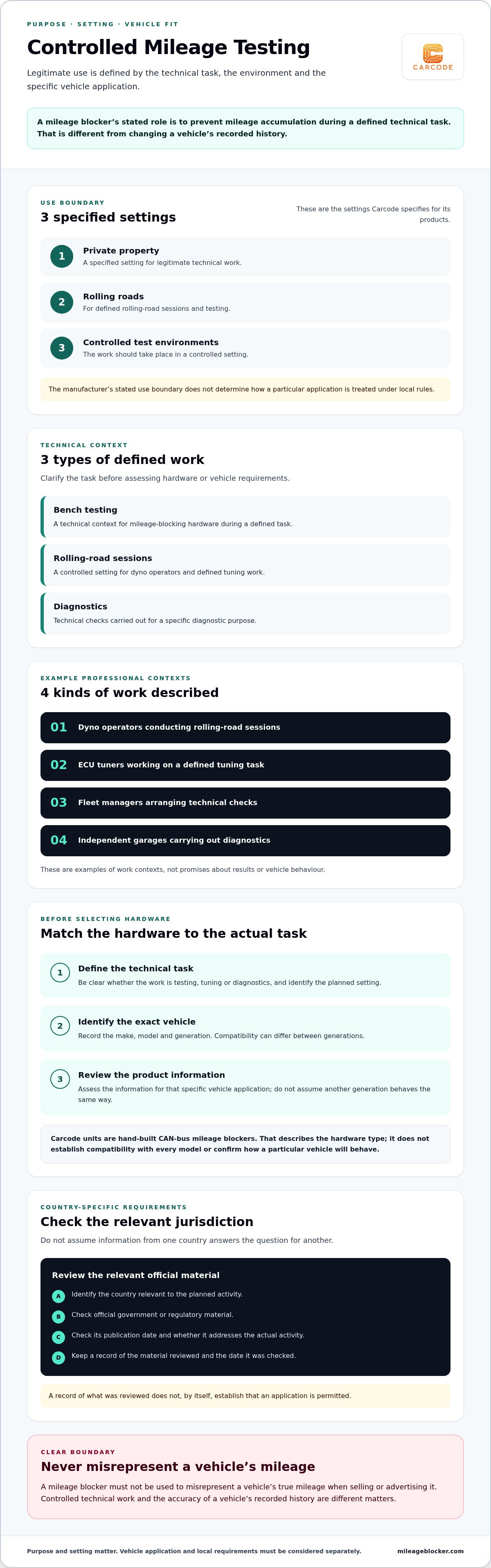
This guide explains legitimate testing, tuning and diagnostic contexts, and why responsible use stays within controlled environments. Carcode mileage blockers are sold strictly for legitimate automotive testing, tuning and diagnostic purposes. They are intended for use on private property, rolling roads and controlled test environments only. It is illegal to use a mileage blocker to misrepresent a vehicle’s true mileage when selling or advertising a vehicle.
The article also explains why readers should not assume one country’s requirements apply everywhere. Carcode Ltd accepts no liability for misuse. By purchasing, customers confirm they will use the product lawfully and responsibly. Carcode mileage blockers are designed, manufactured and supported by Carcode Ltd, with no middlemen, no white-labelling, no compromises. They come with a full warranty and lifetime technical support.
Key Takeaways
- Legitimate mileage-blocking applications focus on defined testing, tuning and diagnostic work in controlled settings.
- Mileage Correction Around the World: Legitimate Uses depends on purpose and setting. Do not assume one legal position applies in every country.
- Before selecting hardware, define the test and identify the exact vehicle application. Compatibility can differ between generations.
- Never use a mileage blocker to misrepresent a vehicle’s mileage when selling or advertising it.
What Does Legitimate Mileage Correction Mean in Automotive Testing?
Here, “legitimate mileage correction” refers to mileage-blocking hardware used for technical automotive work. It does not mean editing an inaccurate vehicle record. These are different activities: one concerns mileage recording during a defined test, while the other concerns the accuracy of a vehicle’s recorded history. Context matters before assessing any technical or professional application.
An odometer records distance travelled, but “mileage correction” is used in different ways in everyday discussion. This article focuses on hardware intended for testing, tuning and diagnostics, not changing a vehicle’s history. Keeping that distinction clear helps readers understand what a mileage blocker is intended for and what it must not be used to do.
To see how the term is used in a broader automotive discussion, watch this video:
Why does the phrase need context?
Search results and everyday conversation may use “mileage correction” for different technical activities. In Mileage Correction Around the World: Legitimate Uses, the phrase has a narrower meaning: mileage-blocking hardware used for a defined technical task. It does not describe changing a vehicle’s history or preparing it for sale. The purpose and setting determine whether a proposed application fits the product’s stated role.
Which settings does Carcode specify?
Carcode specifies use on private property, rolling roads and in controlled test environments. Treat this as the product’s defined-use boundary, not as a universal legal conclusion. It describes the settings Carcode intends; it does not settle how every jurisdiction treats a particular application. Carcode Ltd accepts no liability for misuse. By purchasing, customers confirm they will use the product lawfully and responsibly.
How Mileage Blockers Support Controlled Testing, Tuning and Diagnostics
Bench testing, rolling-road sessions and diagnostic work are distinct technical contexts in which mileage-blocking hardware may be used. Its general function in these applications is to prevent mileage accumulation during a defined task. Before choosing hardware, clarify the test objective and setting. This makes it easier to assess the actual requirements rather than relying on a broad label such as “testing”.
Potential professional applications include dyno operators conducting rolling-road sessions, ECU tuners working on a defined tuning task, fleet managers arranging technical checks and independent garages carrying out diagnostics. These are examples of work contexts, not promises about results or vehicle behaviour. Assess the equipment against the planned task and the specific vehicle, without assuming performance outcomes or uniform behaviour across models.
What does the CAN-bus design tell the reader?
Carcode units are hand-built CAN-bus mileage blockers. This identifies the type of hardware, but does not establish how a particular vehicle’s systems behave or confirm compatibility with every model. The exact vehicle application matters: details for one generation should not be transferred to another. The broader Mileage Blocker: The Ultimate Guide to Odometer Stopper Technology provides additional background on the technology.
How should a professional define the application?
Start by identifying the technical task and the exact vehicle make, model and generation. Then review the product information for that application before planning installation or operation. This keeps the assessment tied to the actual vehicle rather than assumptions based on a similar model. For a defined professional application, discuss the testing requirements with Carcode.
How Should Readers Think About Use Across Different Countries?
A product page covering multiple markets cannot determine how a specific application is treated under local rules. Keep two questions separate: what the manufacturer states about the product’s intended purpose, and what requirements apply where it will be used. Similar terms can be used differently between jurisdictions, so information from one country should not automatically be treated as relevant elsewhere.
Why can’t a global article give one universal legal conclusion?
A reliable answer for a particular country depends on current, jurisdiction-specific information. First identify the country relevant to the planned activity. Then review applicable official government or regulatory material, checking its publication date and whether it addresses the actual activity. A general article, product description or forum discussion may not answer that specific question. If the information is unclear, do not treat an assumption as a legal answer.
Keep a record of the material reviewed and the date you checked it. This does not itself establish that an application is permitted, but it gives a professional decision a clear basis that can be revisited if circumstances or requirements change.
What responsible-use boundary should remain clear?
Use the manufacturer’s stated application as a product boundary, not as proof of what local law allows. Define the technical purpose, planned setting and vehicle application separately. If any of these details changes, review the relevant information again rather than applying an earlier conclusion to a different task or location.
For a defined professional application, discuss the product requirements with Carcode. Product information can support the technical discussion, while country-specific requirements must be considered for the relevant jurisdiction.
What to Review Before Choosing Mileage-Blocking Hardware for Testing
Review the specific vehicle application rather than relying on assumptions about another car with the same badge or model name. For a responsible assessment, work through these steps:
- Define the test. State the technical purpose and confirm that it will take place in a controlled environment.
- Identify the vehicle application. Record the exact make, model and generation, because hardware and compatibility can differ between generations.
- Review the product information. Use details for that specific application. Do not infer operating modes, installation steps or compatibility from another vehicle.
Which product details can readers assess without assumptions?
Carcode units are designed, assembled and tested in the United Kingdom. Assess product information against the exact vehicle application, rather than generalising from another model or generation. The mileage blocker is designed, manufactured and supported by Carcode Ltd, with no middlemen, no white-labelling, no compromises. It comes with a full warranty and lifetime technical support.
Where can readers find related technical information?
For context, review available technical information on how mileage may be stored across multiple ECUs, while remembering that vehicle systems differ. If professional fitting is part of the plan, Carcode’s mileage blocker installation information explains the fitting service. General technical reading and information for another vehicle do not replace the product details for the exact application.
The practical approach to Mileage Correction Around the World: Legitimate Uses is to define the controlled test, identify the vehicle precisely and assess verified information without transferring assumptions between applications. If you are considering a legitimate, controlled testing application, contact Carcode to discuss your application.
Put the Testing Plan into Practice
Before selecting hardware, document the test purpose, the controlled setting and the exact vehicle application. Compare those details with the product information for that vehicle instead of relying on a general description or assumptions drawn from another model. If the work takes place outside the UK, consider the applicable local requirements separately and use current, reliable information for that jurisdiction.
That is the practical value of understanding Mileage Correction Around the World: Legitimate Uses. A clear technical plan helps keep the device within its intended testing, tuning or diagnostic role. A vehicle-specific review also reduces the risk of choosing on incomplete assumptions. The aim is to make a considered decision for the actual test, rather than apply one rule everywhere.
Have a defined professional application in mind? Share your vehicle and testing requirements with Carcode to discuss the relevant mileage-blocking hardware. A clear starting point makes the technical conversation more useful and helps you move forward responsibly.
Frequently Asked Questions
What are legitimate uses for a mileage blocker?
Legitimate uses are defined testing, tuning or diagnostic tasks in an appropriate controlled setting. For example, before a bench test, identify the technical objective and the conditions in which it will take place. A mileage blocker is not a service for correcting inaccurate mileage records. Keep the work within its stated technical purpose and maintain clear boundaries around the application.
Can a mileage blocker be used during a rolling-road test?
Yes. A rolling-road session is one of the stated controlled testing contexts. Before selecting hardware, identify the exact vehicle application and review the product information for that vehicle. Do not assume suitability, installation details or operating options transfer from another model. Keep the test within the defined rolling-road environment, not ordinary road use.
Does worldwide shipping mean a mileage blocker is permitted everywhere?
No. Shipping availability does not establish what is permitted in a particular location. For Mileage Correction Around the World: Legitimate Uses, keep product distribution separate from the requirements that apply where a device may be used. Before proceeding in another country, review current, reliable information for that jurisdiction and the specific circumstances. A global article cannot establish one legal answer for every location.
Are mileage blockers suitable for public-road use?
No. Carcode specifies controlled settings for its mileage blockers, not public-road use. Availability for a particular vehicle does not expand the product’s intended setting or establish suitability for ordinary driving. Keep any application within the stated testing, tuning or diagnostic context and designated controlled environment. Product availability or installation does not make a different use appropriate.
What information should a professional review before using a mileage blocker for testing?
Define the technical task and where it will take place. Then identify the vehicle’s exact make, model and generation, and review product information for that application. Follow the installation guidance for the specific vehicle rather than relying on instructions for another model. If the work is outside the UK, consider current, reliable local information separately. This keeps technical selection and jurisdictional considerations distinct.
About the author
MileageBlocker TeamThe MileageBlocker Technical Team covers vehicle electronics, CAN and CAN-FD systems, mileage blocker compatibility, installation and product developments.
View author profile →