
Engine Hours to Miles: The Ultimate Conversion Guide for Vehicle Health
Is your odometer lying? Learn the definitive method to convert engine hours to miles and uncover a vehicle's true wear, value, and maintenance needs.

A vehicle's odometer is an incomplete metric. For fleet managers, equipment operators, and any driver navigating heavy city traffic, mileage fails to capture the true extent of engine wear from idling and low-speed operation. If you've ever suspected a low-mileage vehicle has more wear than it should, you are likely correct. The key to uncovering the truth lies in a more precise measurement: converting engine hours to miles.
This definitive guide moves beyond simplistic online calculators. We provide the technical knowledge and specific formulas to accurately assess a vehicle's operational life based on its usage patterns-from highway driving to intensive city use. By mastering this conversion, you will gain the ability to schedule maintenance with precision, evaluate the true condition and value of any used vehicle, and gain total confidence in its mechanical integrity.
Key Takeaways
- Understand why a vehicle's odometer reading is an incomplete measure of its true condition and how engine hours reveal critical wear from idling.
- Learn a practical, step-by-step method to convert engine hours to miles, providing a far more accurate picture of your engine's operational life.
- Discover the industry benchmarks for engine hour to mile ratios, allowing you to quickly identify if a vehicle has been subjected to excessive or harsh use.
- Leverage engine hour data to schedule proactive maintenance based on actual wear and more accurately assess a used vehicle's true market value.
Why Miles Don't Tell the Whole Story: Understanding Engine Hours
When assessing a vehicle's condition, most people look straight to the mileage. While the figure displayed on the Odometer is a standard indicator, it only measures distance travelled-not the total stress and runtime the engine has endured. Engine hours, the total time an engine has been running, provide a far more accurate picture of its internal wear and tear. This data is fundamental to understanding the true health of a vehicle's powertrain.
To better understand this concept, watch this helpful video explanation:
Consider this analogy: a vehicle used for city driving is like a boxer in a fight-short bursts of high-intensity activity with constant starting and stopping. It covers little ground but undergoes immense stress. In contrast, a vehicle that has spent its life on the motorway is like a marathon runner-long periods of steady, low-stress operation covering vast distances. The boxer's body (the engine) might be more worn despite the shorter distance covered.
This principle of tracking operational time isn't just for industrial machinery; it's a concept familiar to hobbyists who value precision. For example, in the world of model railways, enthusiasts meticulously track the runtime of their locomotives to schedule maintenance on tiny, intricate motors. This attention to detail ensures their complex miniature worlds run smoothly, and resources like Narrow Minded Railworks cater to this passion for precision engineering.
This is why engine hours are the primary metric for assessing equipment where distance is secondary, such as:
- Heavy-duty commercial trucks
- Agricultural machinery (tractors, combines)
- Marine engines on boats
- Stationary power generators
Mileage vs. Engine Hours: A Head-to-Head Comparison
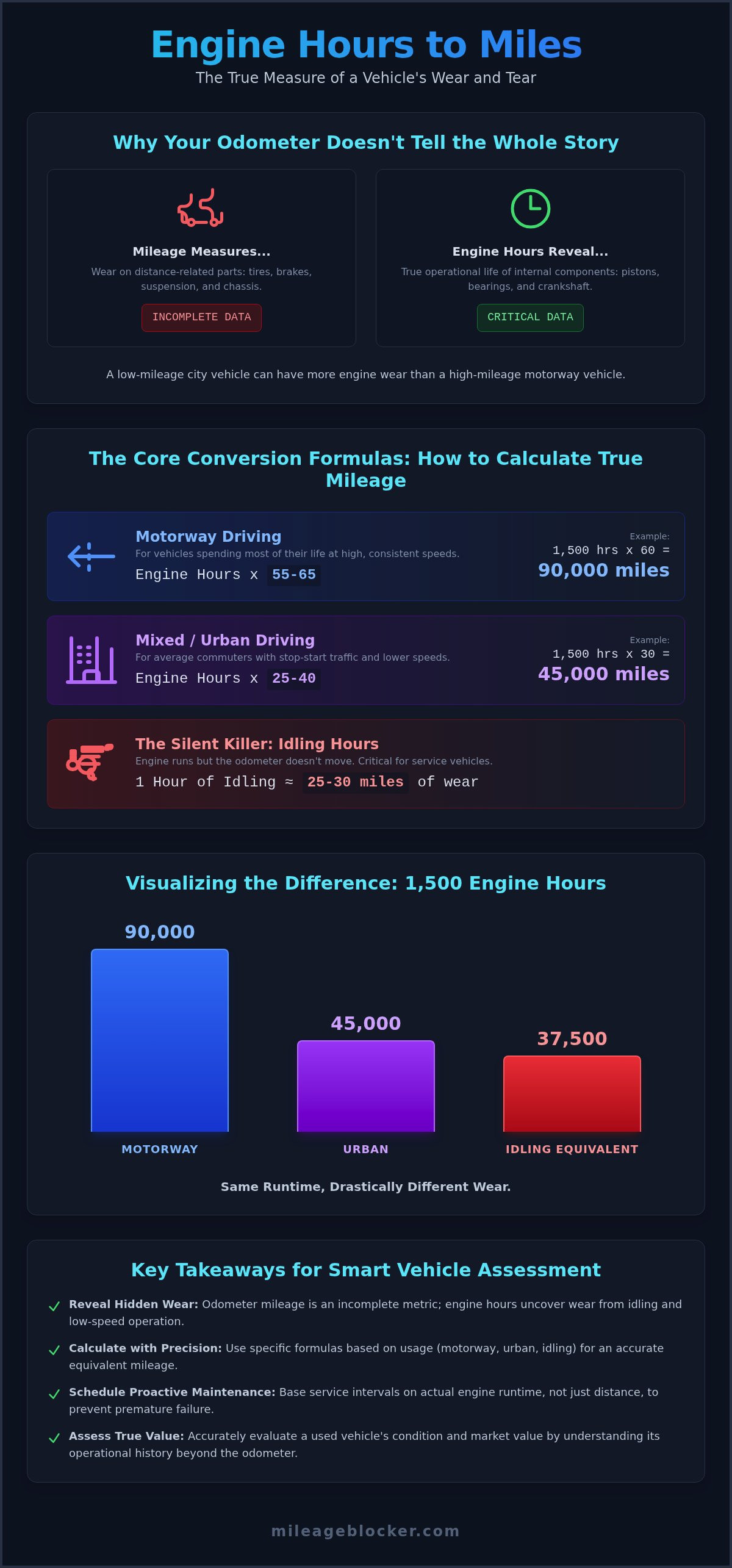
Mileage primarily indicates wear on components related to distance: tyres, suspension, brakes, and the chassis. Engine hours, however, directly measure the operational life of internal components like pistons, bearings, and the crankshaft. A vehicle with 100,000 motorway miles may have significantly less engine wear than one with just 30,000 miles of stop-start city traffic. This is where a proper engine hours to miles calculation becomes critical for a true valuation.
The Critical Role of the Engine Hour Meter
An engine hour meter is a gauge that records the cumulative time an engine has been in operation. Historically a staple in commercial and industrial equipment, this tool provides the most reliable data for maintenance schedules. While most modern passenger cars in the UK do not display an hour meter on the dashboard, the Engine Control Unit (ECU) meticulously tracks this data internally. This information is a core diagnostic metric used by technicians to assess an engine's operational history and condition.
The Core Conversion Formulas: From Simple Estimates to Accurate Calculations
Many online sources suggest a crude calculation: simply multiply the engine hours by 60. While this provides a quick figure, it assumes the vehicle has maintained an average speed of 60 mph for its entire operational life-a scenario that is highly unrealistic for most vehicles in the UK. This one-size-fits-all approach fails to account for traffic, idling, and urban driving, leading to significant inaccuracies.
The fundamental principle of any accurate engine hours to miles conversion is that the conversion factor is simply the vehicle's true average speed. To get a realistic equivalent mileage, you must use a multiplier that reflects the vehicle's typical usage pattern. Below are three distinct methods to achieve a more precise calculation.
Method 1: The Motorway Driving Formula
This formula is best suited for vehicles that spend the vast majority of their time on motorways or A-roads, such as long-haul lorries or sales fleet cars. For this type of usage, a conversion factor of 55 to 65 miles per engine hour is a reliable estimate.
- Example: A vehicle with 1,500 engine hours used predominantly for motorway travel.
- Calculation: 1,500 hours x 60 mph = 90,000 equivalent miles.
Method 2: The Mixed/Urban Driving Formula
For the average commuter or a vehicle used primarily for city driving, the average speed is drastically lower due to stop-and-go traffic, traffic lights, and lower speed limits. A more appropriate conversion factor for these vehicles is between 25 and 40 miles per engine hour.
- Example: The same vehicle with 1,500 engine hours used for daily commuting in a city.
- Calculation: 1,500 hours x 30 mph = 45,000 equivalent miles.
Method 3: The Idling Hours Formula (The Silent Killer)
Idling is the most deceptive form of engine wear. The engine is running-accumulating wear on critical components-but the odometer remains static. The industry standard rule of thumb is that one hour of idling is equivalent to driving 25-30 miles. This is especially critical for service vehicles like police cars, delivery vans, and utility trucks that spend a significant portion of their time stationary with the engine on. This principle is a cornerstone of maintenance protocols for many professional UK fleets, including emergency services, utility companies, and delivery services, where engine hours are often considered the primary metric for servicing, rather than just the mileage displayed on the dashboard.
A Practical Guide to Calculating Your Vehicle's Equivalent Mileage
Understanding the theory is one thing; applying it is another. This section provides a direct, step-by-step process to perform an engine hours to miles conversion for your own vehicle. By following these steps, you can gain a more accurate understanding of the true wear and tear on your engine, moving beyond the simple figure displayed on your odometer.
Step 1: Find Your Vehicle's Total Engine Hours
The first piece of data you need is the total time your engine has been running. This is recorded by the vehicle's Engine Control Unit (ECU). There are several ways to access this information:
- Vehicle Information Centre: Many modern cars, vans, and lorries display engine hours directly in the dashboard menu, often near the trip computer data.
- OBD-II Scanner: A more technical method is to use an OBD-II (On-Board Diagnostics) scanner. These devices plug into your vehicle's diagnostic port and can read a wide range of data directly from the ECU, including total engine hours.
- Consult a Dealer: If you cannot find the data using the methods above, your vehicle's main dealer can access it using their proprietary diagnostic equipment.
Step 2: Determine Your Average Speed
Next, you must establish the vehicle's average speed over its lifetime. If your trip computer displays this figure, you can use it directly. However, a more precise method is to calculate it manually. Simply divide the total miles on your odometer by the total engine hours you found in Step 1.
Case Study Example: A Ford Transit van has 60,000 miles on the odometer and the owner finds it has run for 2,500 engine hours. The calculation is: 60,000 miles ÷ 2,500 hours = 24 mph average speed.
Step 3: Calculate and Interpret the Results
With your data collected, the final calculation is straightforward. Use the industry standard average (or your own calculated average) to find the equivalent mileage.
Formula: Total Engine Hours x Average Speed = Equivalent Mileage
Using our Ford Transit example and a standard industry equivalent of 33 mph for mixed-use wear: 2,500 hours x 33 mph = 82,500 equivalent miles. When compared to the 60,000 miles on the odometer, this reveals a 'wear gap' of 22,500 miles, indicating significantly more engine wear than the odometer suggests due to high idle times. For questions about how data is stored in vehicle modules, see our comprehensive MileageBlocker FAQ.
What is a 'Good' Engine Hour to Mile Ratio? (Benchmarks & Red Flags)
After calculating your vehicle's ratio, the next critical step is interpretation. While not an exact science, industry benchmarks provide a clear framework for assessing a vehicle's operational history. For most passenger cars in the UK, a healthy average is approximately 30-40 miles for every hour the engine has run. A significant deviation from this benchmark can reveal a great deal about the vehicle's past life and potential future maintenance needs.
Here is a simple guide to interpreting the results:
- Ideal Ratio (Low Hours, High Miles): Typically above 45-50 miles per hour. This suggests gentle, long-distance motorway driving.
- Average Ratio (Balanced): Around 30-40 miles per hour. This indicates a healthy mix of city and motorway use.
- Concerning Ratio (High Hours, Low Miles): Below 20-25 miles per hour. This points to excessive idling or severe stop-start city traffic.
Interpreting High Hours and Low Miles
A high hour count relative to the mileage on the odometer is a clear indicator of a hard life, dominated by idling or heavy urban traffic. While the mileage may seem appealingly low, the engine has worked hard. This type of use is particularly stressful on key components like turbochargers and Diesel Particulate Filters (DPFs), which can clog without regular high-speed runs. It also accelerates oil degradation, meaning the vehicle may require more frequent servicing than its mileage suggests.
Interpreting Low Hours and High Miles
This is generally the ideal scenario for engine health. It signifies that the majority of the miles were accumulated during long-distance motorway driving. In these conditions, the engine operates at a stable temperature with minimal thermal stress, resulting in less internal wear per mile. However, do not neglect other components. High mileage still means significant wear on the suspension, brakes, and tyres, which should be inspected thoroughly.
Red Flags for Used Vehicle Buyers
The engine hours to miles ratio is a powerful tool for spotting inconsistencies that could signal a hidden history or even odometer fraud. An unusually low hour count on a high-mileage commercial van, for instance, is a major red flag. Conversely, an extremely high hour count on a standard family hatchback might reveal it was secretly used as a taxi or delivery vehicle. Use this data not as a final verdict, but as a crucial piece of evidence. It justifies a deeper mechanical inspection by a professional and provides a strong basis for price negotiations. For complex vehicles, particularly European models, getting this inspection from a dedicated specialist like Euro Performance Auto Shop LLC is a wise investment.
For professionals involved in vehicle testing and diagnostics, having access to accurate, untampered data is paramount. Understanding every aspect of a vehicle's electronic modules is key to a complete assessment.
Impact on Maintenance, Value, and Professional Vehicle Testing
Understanding the conversion of engine hours to miles moves beyond a simple calculation into the realm of significant financial consequences. This data directly impacts your vehicle's mechanical health, its resale value, and is a cornerstone of professional automotive testing. Applying this knowledge correctly can prevent costly repairs and empower you during vehicle transactions.
Adjusting Maintenance Schedules Based on Engine Hours
For vehicles with high idle times, such as delivery vans in city traffic or utility trucks on-site, relying on the odometer for service intervals is a critical error. An engine idling for just one hour can create wear equivalent to driving over 30 miles. Sticking to a mileage-based oil change can lead to premature sludge buildup and component failure. Adopting an hour-based schedule (e.g., every 200-250 hours) is a far more accurate measure of engine wear, helping you avoid catastrophic failures that can cost upwards of £5,000 to repair.
Other key services to consider tracking by hours include:
- Transmission fluid changes
- Air and fuel filter replacements
- Coolant system flushes
How Engine Hours Affect Resale Value
In the UK's used commercial vehicle market, experienced dealers and buyers always check engine hours. They understand that mileage alone doesn't tell the full story. A van showing just 50,000 miles but logging 3,500 engine hours has likely endured a harsh life of stop-start driving, placing immense stress on the engine and drivetrain. This discrepancy makes the vehicle worth considerably less than its low mileage might suggest. This knowledge is a powerful negotiation tool when buying and essential for setting a realistic price when selling.
Engine Hours in Vehicle R&D and Testing
Automotive engineers rely on runtime, not distance, for critical durability testing. During development, an engine may be run on a dynamometer for hundreds of hours to simulate a lifetime of wear in a controlled environment. In these off-road or test-track scenarios, mileage accumulation is an unwanted variable that can corrupt the data.
To isolate engine performance and gather pure runtime data, testing professionals must pause the odometer. This requires specialised tools that interface with the vehicle's complex electronic systems. For popular brands like Honda, specific solutions are available to facilitate this type of controlled testing, ensuring data integrity for accurate product development. For professionals engaged in legitimate vehicle testing, such modules are an indispensable part of the process.
Beyond the Odometer: Mastering Your Vehicle's True Condition
Ultimately, looking beyond the odometer is essential for a true assessment of vehicle health. While miles travelled are a useful metric, engine hours tell the complete story of mechanical stress, idling time, and operational intensity. By learning to calculate and interpret the engine hours to miles ratio, you gain a powerful advantage in predicting maintenance needs, assessing true market value, and ensuring the long-term reliability of your vehicle or fleet.
For professionals engaged in vehicle diagnostics, development, or off-road testing, precise control over data logging is paramount. Our advanced solutions are engineered from genuine, high-quality components to deliver a completely untraceable effect, ensuring data integrity during legitimate testing cycles. Built for performance and backed by worldwide delivery and lifetime support, these tools offer an unparalleled level of control. Explore Professional Tools for Vehicle Testing & Data Management to equip yourself with the superior technology modern vehicles require.
Frequently Asked Questions
How many miles is 1 hour of engine time?
There is no universal conversion, as it depends entirely on driving conditions. For a vehicle used primarily on motorways at an average of 60 mph, one hour equals 60 miles. However, for vehicles in heavy city traffic or those that idle frequently, the average speed is much lower. A commonly used industry rule of thumb for mixed-use vehicles is to equate one engine hour to approximately 30-33 miles of driving to account for idling and low-speed operation.
What are the average engine hours for 100,000 miles on a passenger car?
The average can vary significantly based on usage patterns. A car driven mostly on motorways might achieve 100,000 miles in as few as 1,700-2,000 hours. Conversely, a vehicle used for city commuting or as a taxi could easily accumulate 3,000-4,000 engine hours over the same distance due to traffic and idling. A general estimate using the 33-mile-per-hour rule would place the average around 3,000 hours, but individual vehicle history is critical for an accurate assessment.
Does engine idling add miles to a car's odometer?
No, engine idling does not add miles to a vehicle's odometer. The odometer measures the distance a car has travelled, which is typically calculated based on wheel rotation or transmission output speed. When a vehicle is stationary with the engine running, it accumulates engine hours and causes wear on engine components, but since no distance is covered, the odometer reading remains unchanged. This is why engine hours are a crucial secondary metric for vehicle wear.
How can I check the engine hours on my specific car model?
Accessing engine hour data varies by manufacturer and model. Many modern commercial vehicles and high-end passenger cars display this information within the instrument cluster's menu or the main infotainment system. For other vehicles, a professional-grade OBD-II diagnostic scanner plugged into the car's ECU is required to read the data. Always consult your vehicle's owner's manual first, as it will specify if this feature is user-accessible and how to find it.
Is it better to buy a used car with high miles or high engine hours?
It is generally better to buy a vehicle with high miles and low engine hours. This combination typically indicates consistent motorway driving, which causes less stress on the engine, transmission, and brakes per mile. A car with low miles but high engine hours suggests extensive idling or city use, which can cause significant engine wear not reflected by the odometer. Evaluating the engine hours to miles ratio provides a more accurate picture of a vehicle's true condition.
Can engine hour data be altered or tampered with?
Yes, altering engine hour data is possible with sophisticated diagnostic and programming tools. The data is stored within the vehicle’s Engine Control Unit (ECU) and, like the odometer reading, can be manipulated. This process is complex and often requires more specialised equipment than simple odometer correction. While difficult, it is a known issue in the used vehicle market, making a comprehensive mechanical inspection and vehicle history check essential before any purchase.
Why do diesel trucks and heavy equipment always show engine hours?
Diesel trucks and heavy equipment rely on engine hours as the primary metric for two key reasons. First, their operational use often involves extensive idling or running power take-off (PTO) systems while stationary, making mileage an inaccurate measure of wear. Second, maintenance schedules for these heavy-duty engines are based on operating hours, not distance. Oil changes, filter replacements, and major service intervals are all determined by how long the engine has been running.
About the author
MileageBlocker TeamThe MileageBlocker Technical Team covers vehicle electronics, CAN and CAN-FD systems, mileage blocker compatibility, installation and product developments.
View author profile →