
Audi Mileage Blocker Guide: Architecture, Compatibility, and Testing in 2026
Learn how an Audi mileage blocker filters live CAN bus data across modern platforms like MQB Evo. Protect your odometer integrity during dynamometer testing.

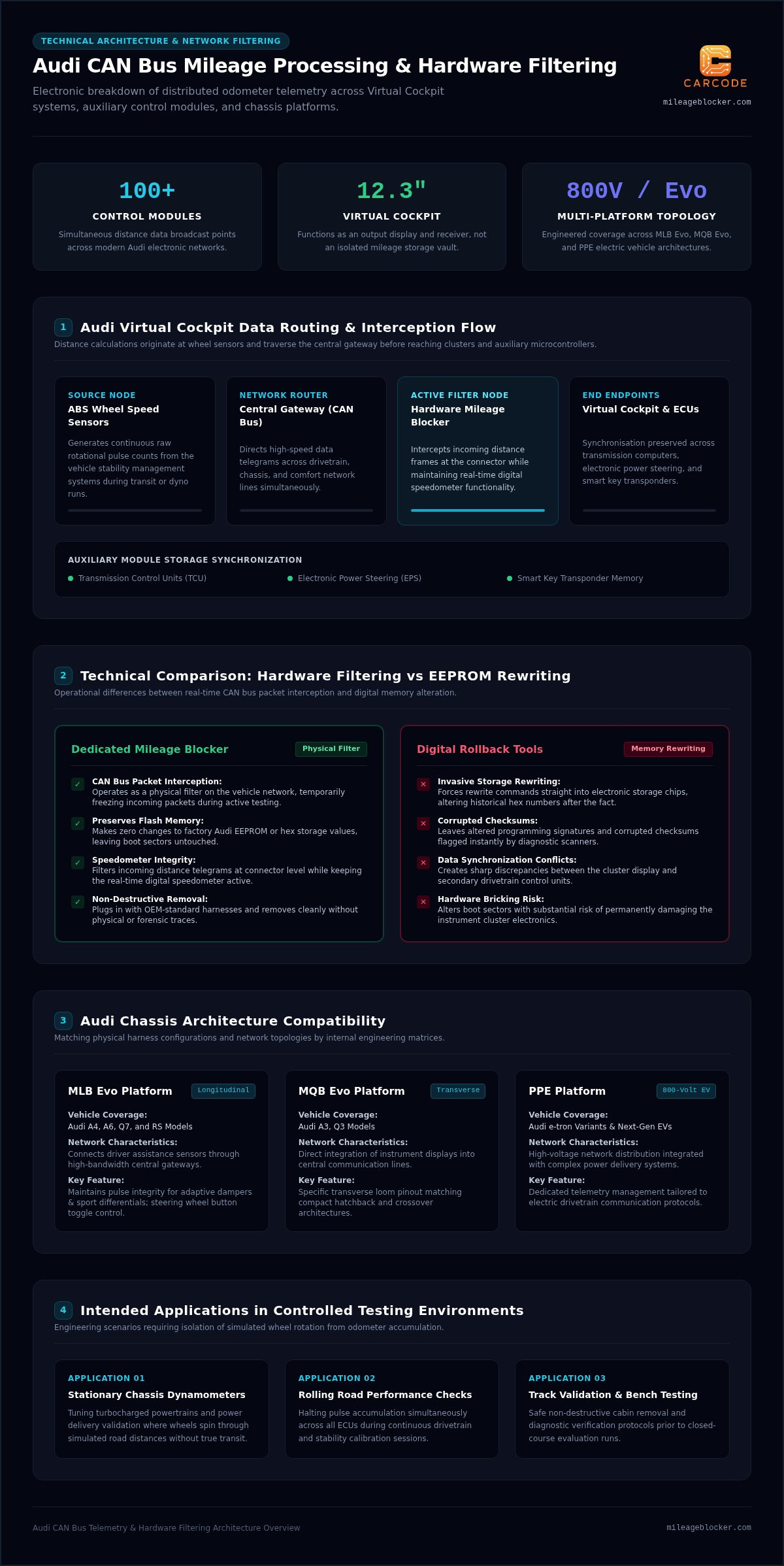
In a modern Audi, mileage data does not live solely behind the Virtual Cockpit; it is broadcast across more than 100 separate control modules simultaneously. Splicing into delicate factory looms or risking crude digital rollback tools will inevitably trigger persistent CAN bus fault codes across your network. That is why selecting a dedicated audi mileage blocker for stationary dynamometer runs and track validation demands precision hardware rather than invasive rewiring.
We know how vital it is to protect complex electronic architectures without losing speedometer accuracy or disabling active safety systems during testing. In this guide, you will gain a clear electronic breakdown of live CAN bus filtering versus flash memory alteration, explore plug-and-play integration across MQB Evo, MLB Evo, and PPE platforms, and see how OEM-standard harnesses maintain complete digital integrity. Here is how modern testing hardware operates behind the glass.
Key Takeaways
- Understand how the Audi Virtual Cockpit functions as a live data receiver rather than an independent mileage repository across modern CAN bus networks.
- Discover why an authentic audi mileage blocker prevents data synchronisation conflicts without corrupting sensitive microcontrollers or leaving forensic rollback markers.
- Identify crucial architectural differences across MQB Evo, MLB Evo, and 800-volt PPE platforms to select the correct physical harness for your vehicle.
- Learn safe bench testing, non-destructive cabin removal, and diagnostic verification protocols before running stationary dynamometer sessions.
How Audi Virtual Cockpit Architecture Processes Mileage Data
Modern Audi vehicles do not treat the 12.3-inch Virtual Cockpit as an isolated odometer. Instead, distance calculations originate from ABS wheel speed sensors and travel across the Controller Area Network (CAN bus) directly through the central gateway. The digital cluster functions purely as an output display rather than a closed storage vault. When validating power delivery on a stationary dynamometer, an audi mileage blocker intercepts raw distance telegrams before the instrument cluster calculates accumulated mileage.
To see how physical filtering functions during workshop testing, watch this installation demonstration:
CAN Bus Communication in Modern Audi Vehicles
The central gateway acts as a high-speed router, directing packets between drivetrain, chassis, and comfort network lines. Distance figures calculate continuously from rotational counts broadcast by the stability management systems. Dedicated hardware modules filter incoming distance frames at the connector while keeping the real-time digital speedometer fully active. In our workshop testing, maintaining this separation is vital; just as high-performance setups rely on a McLaren 720S mileage blocker on the rollers, Audi platforms require dedicated CAN packet management to run cleanly.
Storage Points Across Auxiliary Control Units
Mileage figures never sit in one single place. Audi architectures mirror vehicle operating metrics across transmission computers, electronic power steering units, and smart key transponders. Incomplete blocking solutions only mask the dash display, creating sharp diagnostic discrepancies between your cluster and drivetrain computers. Quality hardware blocks data propagation across all secondary microcontrollers simultaneously, ensuring diagnostic scans report no synchronisation conflicts.
Audi Mileage Blocker vs Odometer Rollback Tools
Odometer rollback tools force rewrite commands straight into electronic storage chips. That invasive approach permanently alters stored hex values inside the EEPROM, leaving corrupted checksums that diagnostic scanners flag instantly. In contrast, an audi mileage blocker operates as a physical filter on the vehicle network. It prevents fresh distance telemetry from being written while keeping the underlying factory code untouched.
Operational Differences Between Hardware Filtering and Memory Rewriting
Software adjustment tools change historical numbers after the fact. Hardware stoppers temporarily freeze incoming packets during active testing sessions. While NHTSA estimates on odometer fraud highlight the widespread risks of deceptive digital tampering, physical filtering provides a non-destructive method for engineering use. We see frequent cluster failures when amateur software corrupts boot sectors; hardware filters avoid this entirely by making zero changes to Audi flash memory.
- Rollback Tools: Rewrite EEPROM storage lines, leave altered programming signatures, and carry heavy risks of bricking the instrument cluster.
- Mileage Blockers: Intercept live CAN broadcast packets, preserve original system parameters, and remove cleanly without physical traces.
Intended Applications in Controlled Environments
Controlled evaluation environments require isolating test cycles from standard odometer calculations. When tuning a turbocharged powertrain on a chassis dyno or running prolonged rolling road checks, wheels spin through simulated road distances without true transit. A dedicated mileage stopper maintains system integrity by halting pulse accumulation across all ECUs throughout the session. If your workshop handles complex drivetrain calibrations, feel free to speak to our technical team about selecting the proper harness configuration.
Audi Platform Compatibility: MLB Evo, MQB, and PPE Architectures
Selecting an audi mileage blocker requires matching internal chassis architecture rather than exterior model badging. Audi groups vehicles under specific engineering matrices that share identical network topologies and pinout layouts. A compact hatchback shares zero dash loom hardware with an executive saloon. Always verify your specific chassis series using our vehicle selector prior to bench runs, ensuring strict adherence to off-road testing guidelines and broader NHTSA Odometer Fraud Regulations regarding device deployment.
Longitudinal Platforms: Audi A4, A6, Q7, and RS Models
Longitudinal models built on the MLB Evo platform connect sophisticated driver assistance sensors directly through high-bandwidth central gateways. In high-performance RS models, the filter firmware must maintain pulse integrity so adaptive dampers and sport differentials calculate lateral acceleration correctly. Most MLB Evo blockers let you toggle operating modes using existing steering wheel buttons, meaning you do not have to access the physical unit once fitted behind the cluster.
Transverse and Electric Platforms: Audi A3, Q3, and e-tron Variants
Transverse layouts utilize the MQB Evo platform, integrating instrument displays directly into the central infotainment bus. Premium EV models introduce even more complexity:
- MQB Evo (A3, S3, RS3, Q3): Employs compact dash connectors with integrated infotainment gateway lines.
- PPE & J1 Architectures (Q6 e-tron, e-tron GT): Operate high-voltage networks that calculate state-of-charge alongside wheel revolutions.
Dedicated blocker hardware provides selectable filtering modes to manage rolling road validation across both combustion and pure electric drivetrains. If you require custom wiring verification for an upcoming dynamometer evaluation, contact our engineering specialists to match the exact harness code to your chassis.
Audi Mileage Blocker Installation, Calibration, and Testing Protocol
Proper physical integration demands patience and strict electrical discipline. Power down the ignition completely, disconnect the negative 12V battery terminal, and wait ten minutes for onboard microcontrollers to enter sleep mode. This precaution prevents stray voltage spikes from registering spurious gateway faults. While many dyno operators handle hardware setup themselves, workshop managers can also book our nationwide mileage blocker fitting service across the UK for factory-calibrated deployment.
Step-by-Step Module Integration Behind the Virtual Cockpit
Clean execution protects delicate interior leather and cluster housings from accidental cosmetic damage:
- Clear workspace: Adjust the steering wheel fully downward and rearward to maximize cluster clearance.
- Release dash trim: Apply non-marring nylon pry tools to detach the lower cluster surround without marking the dash.
- Extract the display: Remove the exposed T20 Torx retaining screws holding the screen housing in place.
- Seat the harness: Slide the cluster forward, unlatch the OEM multi-pin locking collar, and connect the audi mileage blocker inline until the safety lever clicks.
Pre-Dyno Calibration and Functional Verification
Re-secure the display assembly, reconnect your battery terminal, and cycle the vehicle ignition to accessory power. The Virtual Cockpit should initialize immediately without illuminated ABS, traction, or chassis fault warnings. Execute your vehicle's specific steering wheel button toggle (such as holding the High Beam stalk or steering scroll wheel for five seconds) to set the hardware into testing mode. Run a rapid OBD diagnostic scan across the central gateway to confirm that communication stability remains flawless before strapping the chassis to the dynamometer rollers.
Preparing Your Audi for Controlled Testing Validation
Executing accurate dynamometer checks requires complete network stability. Intercepting CAN bus distance telegrams at the cluster harness isolates mechanical wheel spin without corrupting internal EEPROM memory or leaving digital footprints. Matching your chassis platform to an authentic audi mileage blocker featuring OEM-grade mating connectors ensures that secondary drivetrain control units log zero diagnostic fault codes.
Take time this week to inspect your steering shroud and verify your chassis platform code before mounting the car on the rollers. Whether you choose to handle hardware integration inside your own workshop or prefer nationwide UK support from certified technicians, reliable dynamometer evaluation starts with the correct interface. You can book professional fitting or discuss module compatibility with our engineering specialists today, giving you total peace of mind throughout every validation run.
Frequently Asked Questions
Does fitting an Audi mileage blocker require cutting factory wiring?
No, installing an authentic audi mileage blocker requires zero wire cutting or pin splicing. The device utilizes OEM-matching connectors that plug directly inline between your factory harness and the rear of the Virtual Cockpit. This plug-and-play architecture protects the original vehicle loom from damage and allows the module to be removed cleanly at any time, returning the wiring network to its exact stock configuration.
Will the speedometer still show vehicle speed while the blocker is active?
Yes, the digital speedometer continues to display real-time vehicle speed during controlled tests. High-grade hardware filters only the cumulative distance telegrams broadcast to internal memory registers while maintaining active live telemetry. Your dashboard needle or numeric readout responds accurately to acceleration and deceleration, ensuring you have clear visual speed feedback while conducting stationary rolling road assessments or developmental power runs.
Can diagnostic scan tools detect missing mileage after dyno testing?
Professional diagnostic tools scan for communication errors, checksum corruption, and module value discrepancies. Because the hardware halts incoming distance calculation across all auxiliary controllers simultaneously, the transmission unit, ECU, and instrument cluster remain fully synchronised. There are no mismatched memory logs or error codes generated, provided the device was correctly installed and testing occurred in a closed, stationary environment.
Is it possible to switch operational modes while driving on a test track?
You can toggle operational modes on the move using integrated steering wheel controls. Drivers typically hold a factory button sequence, such as the High Beam stalk or steering scroll wheel, for several seconds to cycle filtering levels. Acoustic chimes or subtle indicator flashes confirm mode selection, allowing technicians to switch between bench-testing modes and normal operation without disassembling dashboard trim.
What is the difference between an Audi mileage stopper and mileage correction?
An Audi mileage stopper acts as a live electronic filter, whereas mileage correction tools alter recorded data. Correction software forces invasive rewrite commands into EEPROM memory chips to change historical figures, often leaving corrupt digital footprints. Conversely, a dedicated audi mileage blocker temporarily prevents new distance data from being logged during off-road dynamometer sessions without modifying existing vehicle software or historical values.
About the author
MileageBlocker TeamThe MileageBlocker Technical Team covers vehicle electronics, CAN and CAN-FD systems, mileage blocker compatibility, installation and product developments.
View author profile →